Direct Mail for Local Service Businesses: The System Behind a Bound Report
Why a researched, bound report still gets read when cold email does not, the operations layer that makes it repeatable, and the account math behind it.
- Mail is answered more often than cold email. ANA's self-reported 2023 survey put prospect-list response at 10.8%; 2025 vendor benchmarks put cold email replies at 0.45% to 3.43%.
- The deliverable is not the booklet. It is the research pipeline that turns 'mail a batch of good accounts this week' into a weekly habit nobody dreads.
- A bound report costs real money per recipient, and that is the point. The price forces you to mail only accounts worth that attention.
- The channel pencils on commercial accounts that can send repeat work all year. On a one-off residential callout it loses money on contact, no matter how good the report is.
- Run your first batch to one tight slice, one account type in one metro, before you scale. The math is brutal if the targeting is loose.
Direct mail is one of the most answered outbound channels for winning commercial accounts right now, and very few service businesses run it with any discipline. That gap is the entire opportunity.
Our direct mail work runs from a well-made postcard to the heaviest thing we send: a bound, foil-stamped diagnostic written for one named buyer, sealed in wax, and couriered to a desk. This piece is about that bound report, because it is the format with the most moving parts. The reason it works is almost stupidly simple: the inbox is a war zone and the mailroom is quiet.
The hard part was never the printing. The hard part is the operations layer that turns a vague instruction like 'mail a batch of good-fit accounts this week' into a deliverable a small team can ship every week without burning out. This piece is about that layer, the physical package it produces, and the account math that tells you whether to bother at all.
Why mail beats the inbox in 2026
Cold email got harder because everyone got the same tools at the same time. Vendor benchmarks for 2025 put the average reply rate anywhere from 0.45% (Belkins, 7.5 million emails) to 3.43% (Instantly), and the bar for simply arriving keeps rising as Google, Yahoo and Microsoft enforce stricter rules for bulk senders.
Mail went the other way. The ANA Response Rate Report 2023, published in 2024, put direct mail response at 15.6% for house lists and 10.8% for prospect lists. Treat those as directional: the survey is self-reported and the prospect figure rests on a small base. But even the cautious reading leaves mail well ahead of what a cold email gets.
Attention is the unfair part. An email gets a glance from a skimming human deciding whether to archive. A heavy, sealed report is much harder to ignore, because curiosity is a reflex and nobody throws away something that obviously cost money to make without at least looking. You are not competing for inbox real estate anymore. You are the only thing on the desk that is not a bill.
The operations layer nobody sees
Volume is a process problem, not a creative one. We aim to hold the per-recipient effort constant and remove every decision the team would otherwise re-litigate each week. 4 stations, one weekly cadence.
- 01Account selection
A short weekly list against one tight slice, one account type in one metro. The list comes off a scored lead intelligence layer, not a raw Apollo export, so every account already clears fit and shows at least one trigger (a property added to their portfolio, a permit pulled, a change in facilities staff). The lead intelligence playbook covers how that scoring works.
- 02The research brief
Each account gets a short research brief built from their property or project portfolio, recent permits and local press, the work they have put out to bid, and the contact's own public activity. It is assembled with our research stack, so it costs research time rather than writing time. It is the raw material for the report, not the report itself.
- 03The senior diagnostic
A senior person writes the diagnostic on what we actually see: the service gap, the few highest-leverage fixes, and why this specific company is positioned to act now. Nothing in it is reusable across recipients. If a paragraph could be pasted into another company's report, we cut it.
- 04Print, seal, ship
The diagnostic goes into a matte-black bound booklet with a foil-stamped cover, a hand-signed note, and a wax seal. It ships by tracked courier, not bulk post, so it arrives looking like a decision rather than a mailer.
What makes this survivable is the split between the brief and the diagnostic. Most teams try to write the whole report from scratch and quit by week three. Splitting research from writing means the expensive senior hour only touches finished raw material, and that single decoupling is what turns a heroic one-off into a weekly habit.
What actually lands on the desk
The object matters as much as the words. A premium physical artifact signals that a senior person spent real time before asking for any of yours, which is the exact opposite of the message a templated cold email sends. We build the package with the same creative design bar we hold for a flagship landing page, because the recipient judges your competence by the craft in their hands before they read a sentence.
- Matte-black bound booklet, perfect-bound, heavy stock, designed to feel like an internal board document rather than marketing.
- Foil-stamped cover with the recipient's company name, so it reads as theirs the second they pick it up.
- A hand-signed note from the person who wrote the diagnostic, not a printed signature block.
- A wax seal on the envelope, the cheapest item in the package and the one that most plainly says a person made this.
Add it up, print and binding, foil, the note and seal, courier postage, and the senior hour inside it, and the package costs real money per recipient. That is an absurd cost per touch next to an email, and it is exactly why the channel works. The price is the filter. It forces you to mail only accounts worth that attention, which forces good targeting, which is what keeps the reply rate high.
The account math
Direct mail is an economics decision before it is a channel decision, and the math is one division: cost per package divided by reply rate is your cost per engaged conversation. At a 4 percent reply rate, every conversation costs you 25 packages, research, writing, print and postage included. Put your own numbers in. The result is a disaster when the account can only ever send you one small callout, and a bargain when the account can send you work every month of the year.
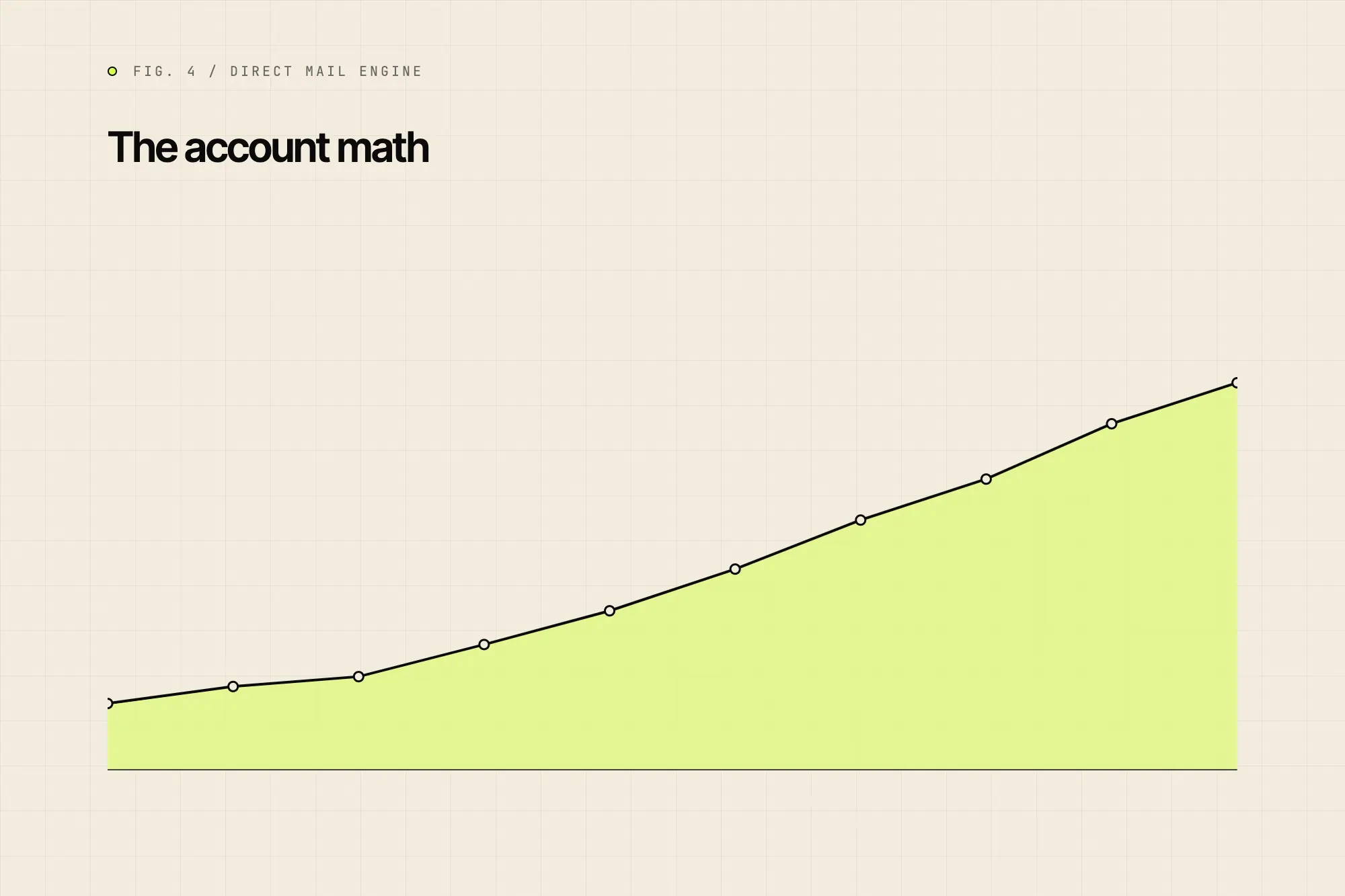
On accounts that can only ever produce a single small job, the channel loses money on contact. You cannot spend 25 packages to open a conversation that ends in one callout. On a property manager, a facilities lead, an adjuster, or a builder the math inverts: one won relationship from a batch can return the program many times over, and a meeting that started with a real diagnostic starts further along than one that started with a calendar link. The report is not a foot in the door. It is the first sales call, delivered before the call.
This is the same logic that governs the whole page library: expensive, high-craft channels earn their place only where the account can carry them. Direct mail is the clearest example of that rule, which is why the bound report is the first format we reach for on commercial and referral accounts and the last one we reach for on one-off residential work.
We build and run the direct mail program, from scored list to sealed package, so your team gets meetings instead of a print project.
Where teams get this wrong
Almost every failed direct mail program we have seen failed in one of 4 predictable ways, and none of them were about the printing. The channel is unforgiving precisely because the cost per touch is high, so a mistake that an email campaign would absorb quietly becomes a line item you can feel.
- Generic reports. The moment a recipient senses the diagnostic could have been mailed to anyone, the spell breaks and the package is wasted. If a paragraph survives a find-and-replace of the company name, it is generic and it has to go.
- Loose targeting. Mailing a pile of lukewarm-fit accounts to hit a volume number is how you turn a strong channel into a weak one. Volume is a reward for tight targeting, not a substitute for it.
- No follow-up. The package earns the open and the attention, then nothing happens because no one sequenced the email or the call that converts that attention into a meeting. The mail is the opening move, not the whole game.
- Wrong account. Running this at accounts that can only ever send you one small job, because the package sounds premium, then quietly killing it when the math never closes. The channel is an economics decision before it is a creative one.
Fix those 4 and the program works. Skip any one of them and you will conclude direct mail is dead, when what actually died was the discipline around it. The medium is not the variable. The operating standard is.
How to run your first 50
Do not start big. Start with one slice narrow enough that you could name the contact's biggest problem before reading the brief. Tight targeting is what carries the reply rate, and a loose first batch will convince you the channel does not work when the real failure was the list.
- 01Pick a single segment where one won account is worth a year of repeat work and you have at least one job story that segment will recognize.
- 02Pull 50 accounts that pass fit and show one live trigger, so the diagnostic has something current to react to.
- 03Write one full report end to end yourself before delegating, so you know what 'good' costs in time.
- 04Ship all 50 in one week, then measure replies and meetings booked at 14 and 30 days, not at 3.
- 05Only scale the segments that produced a meeting. Kill the rest before you spend on another package.
Direct mail is not a volume game pretending to be a quality game. It is a quality game that happens to scale once the operations layer is built. Pair it with a warm outbound sequence to the same accounts and you get a one-two that the inbox-only crowd cannot match, because the mail earns the open and the email earns the follow-up. The email only helps if it arrives, which is what the cold email deliverability post is about.
The inbox is a war zone and the mailroom is quiet. We just send the best thing on the desk and let arithmetic do the rest.
Shivam Bindal
Sources
- 01Belkins, 2026. Cold email response rates
- 02Instantly, 2026. Cold email benchmark report 2026
- 03Google, 2024. Email sender guidelines
- 04Yahoo Sender Hub, 2024. Sender best practices
- 05Microsoft Tech Community, 2025. Strengthening email ecosystem: Outlook's new requirements for high-volume senders
- 06ANA, 2024. ANA Response Rate Report 2023
Written by Shivam Bindal. Founder, Markingo.