
Lead lists and lead intelligence for service businessesThe list
nobody could buy.
Built for your area.
Bought lists are phonebooks. We build yours from public registries, property records, permits and listings, score each row by how likely they are to need your crew, and check it by hand before it ships. Same market, better timing.
Anyone can sell you a phonebook.
We build the call list.
That difference is the entire pitch.
Most list vendors sell the same data to the shop down the road. The work isn’t having a name and an email, it’s having the timing. A new manager, a permit pulled, a claim filed, a building past its service life, that is what gets answered. We just decided to build the list that gets answered.
Four benches. One scored list.
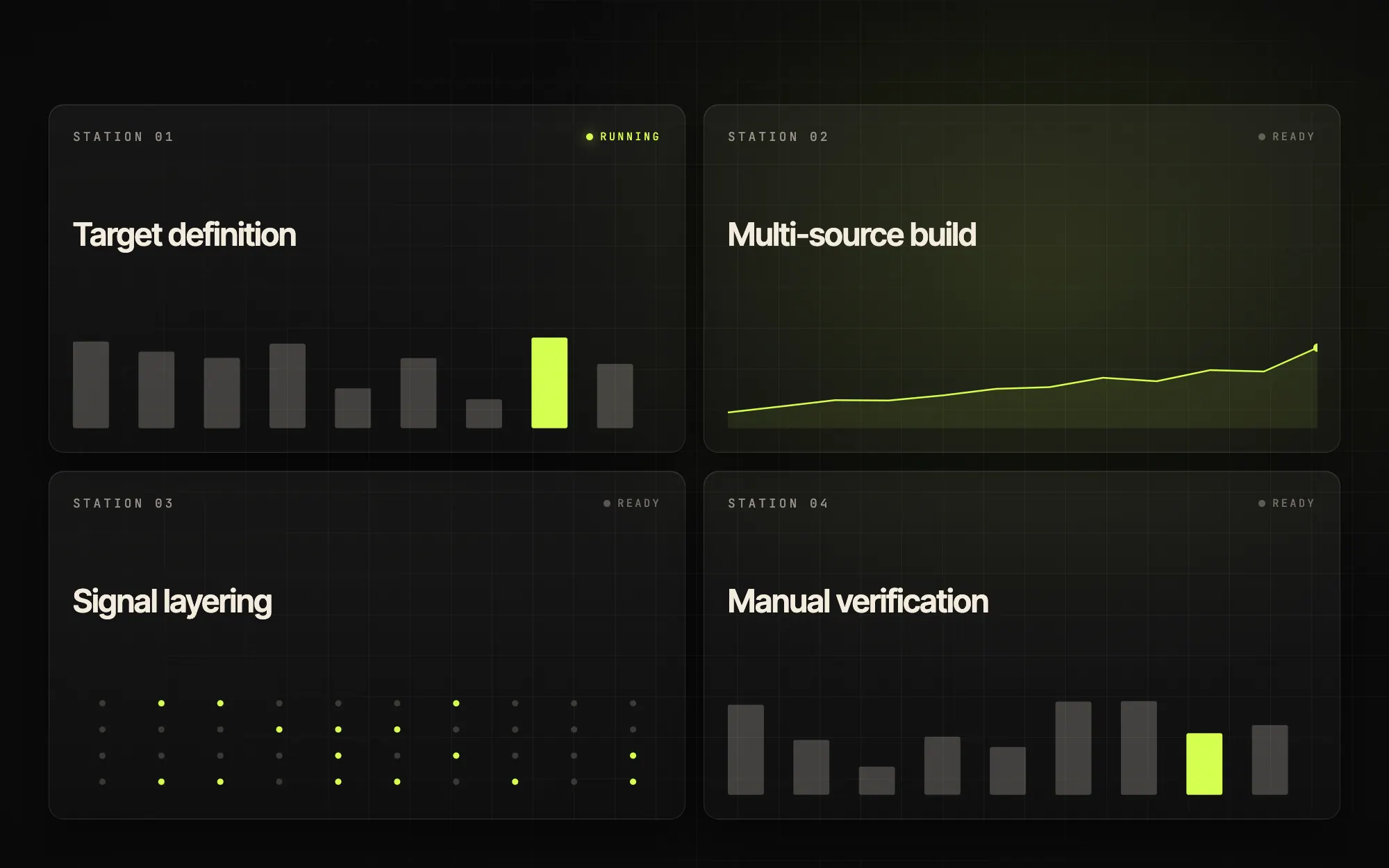
Define, pull, layer, verify. Each bench owns one part of the list, run as a discipline rather than a tool licence. Whether the list holds up comes down to the fourth bench, the one most vendors skip.
 the.observatory
- Bench 01
Define the target
Most lead lists fail before the building starts, because nobody wrote down who they wanted. We pin it: the trade, the property type, the size of the portfolio, who manages it, the postcodes you will actually drive to, and what has to have happened for them to need you this month. A written brief, signed off before a single source is queried.
- Bench 02
Pull the sources
Public business registries, property and strata records, licensing boards, permit filings, Google Business Profiles, review platforms, job boards and local news, pulled in parallel and reconciled into one record per business. Every source is checked against the others, so one company is one row.
- Bench 03
Add the signal
What they own, what they manage, and what just changed. We layer portfolio size, building age, recent permits, ownership and manager changes, review volume and public complaints, and whoever they used last time where the record is public. The list goes from a list of companies to companies with the problem right now.
- Bench 04
Verify by hand
Automated tools get plenty wrong and never tell you which part. Every list goes to the human bench: rows pulled at random and checked against the company's own site, its listing, and its licence record. If the sample comes back weak, the list goes back to be rebuilt before it reaches you.
Six layers. One verified buyer.
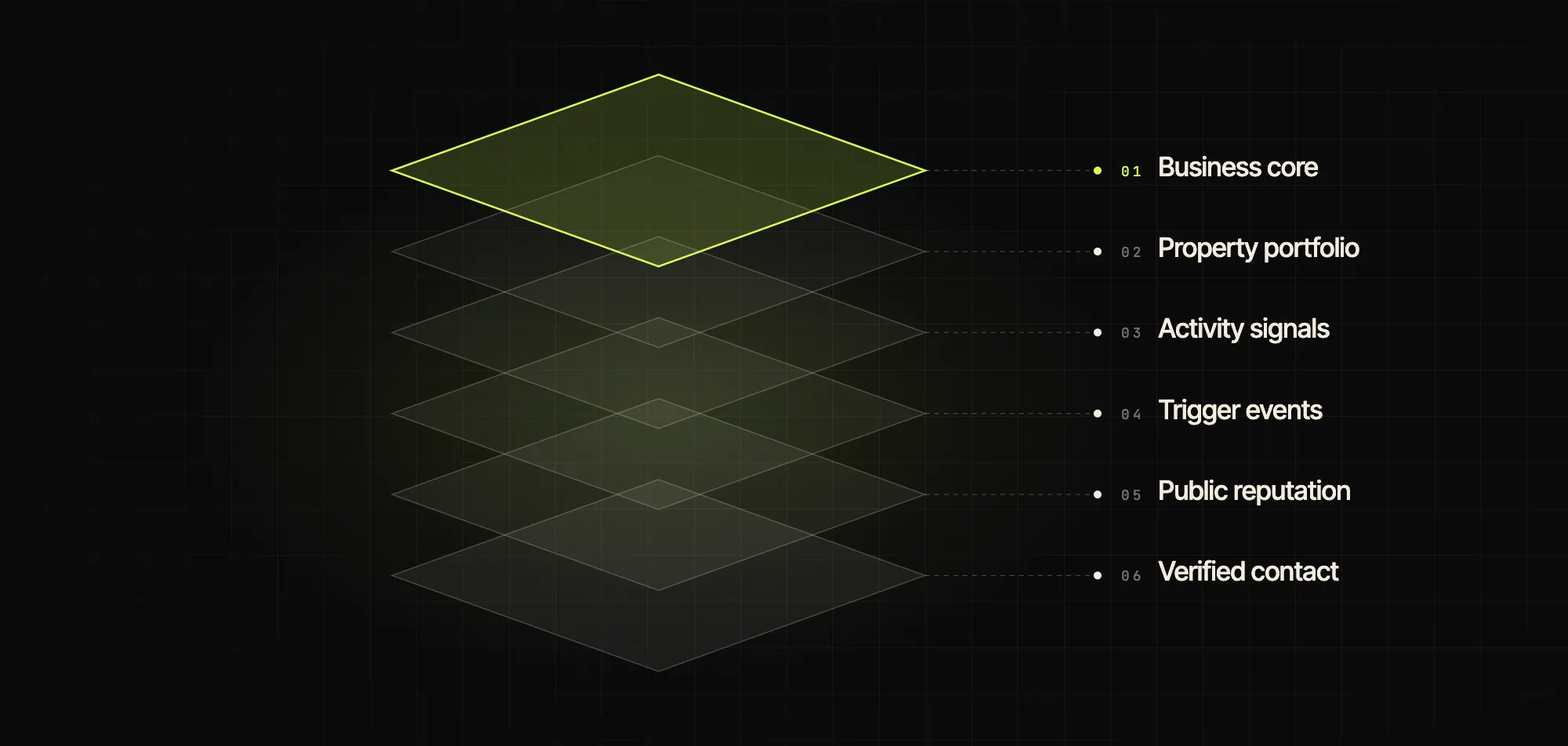
Every row in the list is a stacked dossier, six discrete signal layers, each from a different source, each with its own shelf life and its own QA path. That layering is the difference between “a name on a sheet” and “a manager with a problem this month”.
- /01
Business core
Trade · size · years trading · service area · ownership.
- /02
Property + portfolio
Buildings owned or managed · type · age · unit count.
- /03
Activity signals
Permits filed · jobs posted · new sites · recent expansion.
- /04
Trigger events
Change of manager · claim filed · tender posted · sale closed.
- /05
Public reputation
Review volume · rating trend · complaints · what they publish.
- /06
Verified contact
Decision-maker named · email validated · phone checked live.
 qa · 5 checks
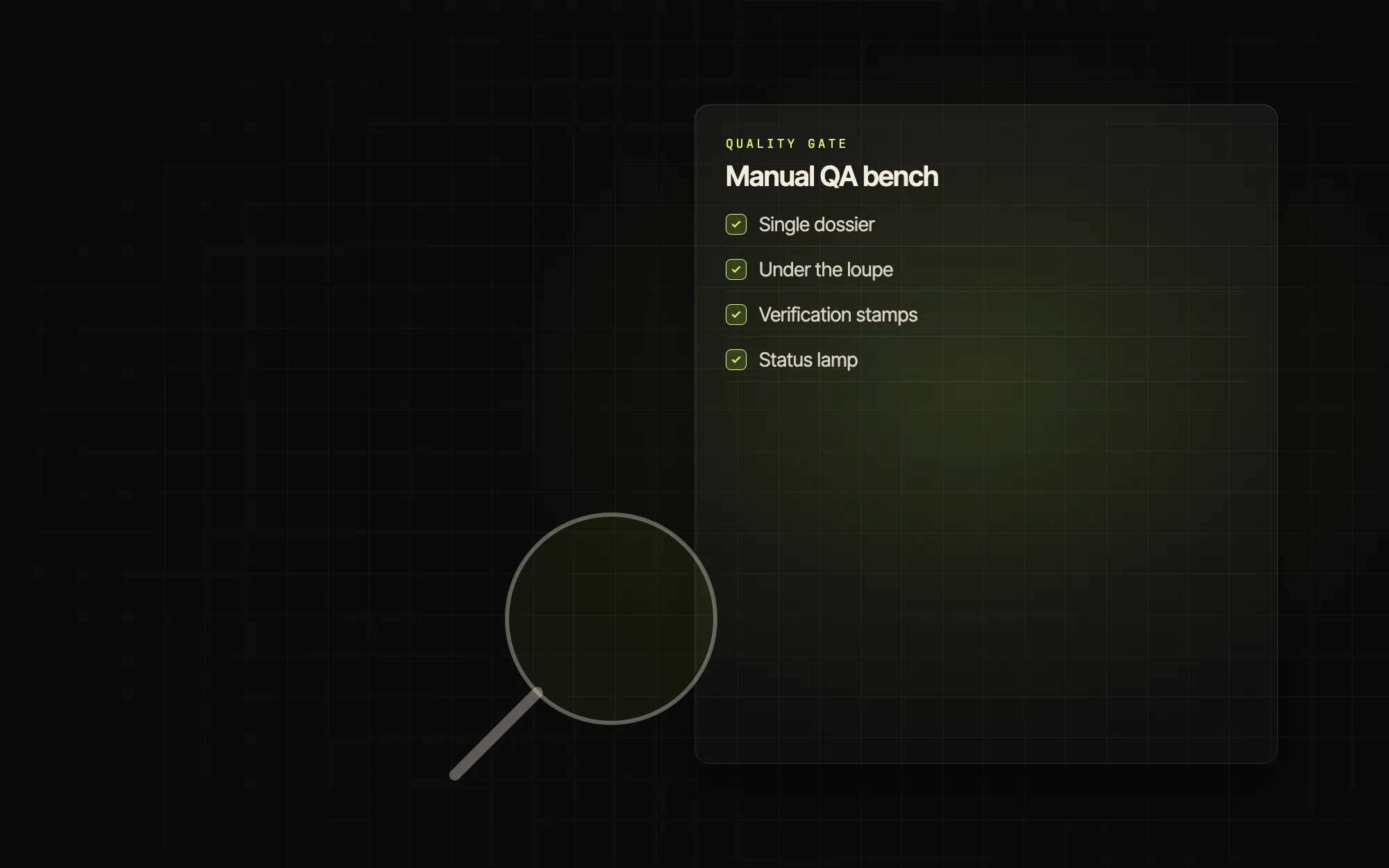
Five checks. Zero phonebook.
Every list clears five checks before it leaves the bench. Source-dedup, contact validation, sanity check, fit scoring, and a manual sample audit on rows pulled at random. If the sample comes back weak, the list goes back to be rebuilt before you see it.
- /01
Source dedup
Records reconciled across every source we pulled. One row per business, with the sources that agreed on it listed.
- /02
Contact verification
Hunter + ZeroBounce + SMTP-ping triple-check on email, phone numbers dialled. Shared inboxes are split out and labelled.
- /03
Sanity check
Trade, size and service area checked against the company's own site and listing. Closed businesses and duplicates dropped.
- /04
Score & rank
Each row gets a fit score blending what they own, what just changed, and how reachable the decision-maker is. Top slice flagged for the first calls.
- /05
Sample audit
Rows pulled at random and checked by hand against the company site, the listing, and the licence record. Weak samples go back to the bench.
Five days. One scored cohort.
- MON
Brief
Target locked, trigger filters set, source list scoped, the standard agreed in writing.
- TUE
Build
Sources pulled in parallel, registries, property records, permits, listings, review platforms, local news.
- WED
Layer
Portfolio, building age, permits and manager changes layered. Records reconciled to one row per business.
- THU
QA bench
Contact validation, sanity-check, fit scoring, manual sample audit. Failures sent back to be rebuilt.
- FRI
Handoff
Cleaned list pushed to your CRM and outbound tool. Source, score and reason to call logged on every row.

Anyone can buy a list. We build the dossier, every source, six layers, one person signing off the row.
Source reconciliation, trigger overlay, manual sample audit. The part nobody pays for is the part that decides whether the next call lands.
What the lab actually hands over.
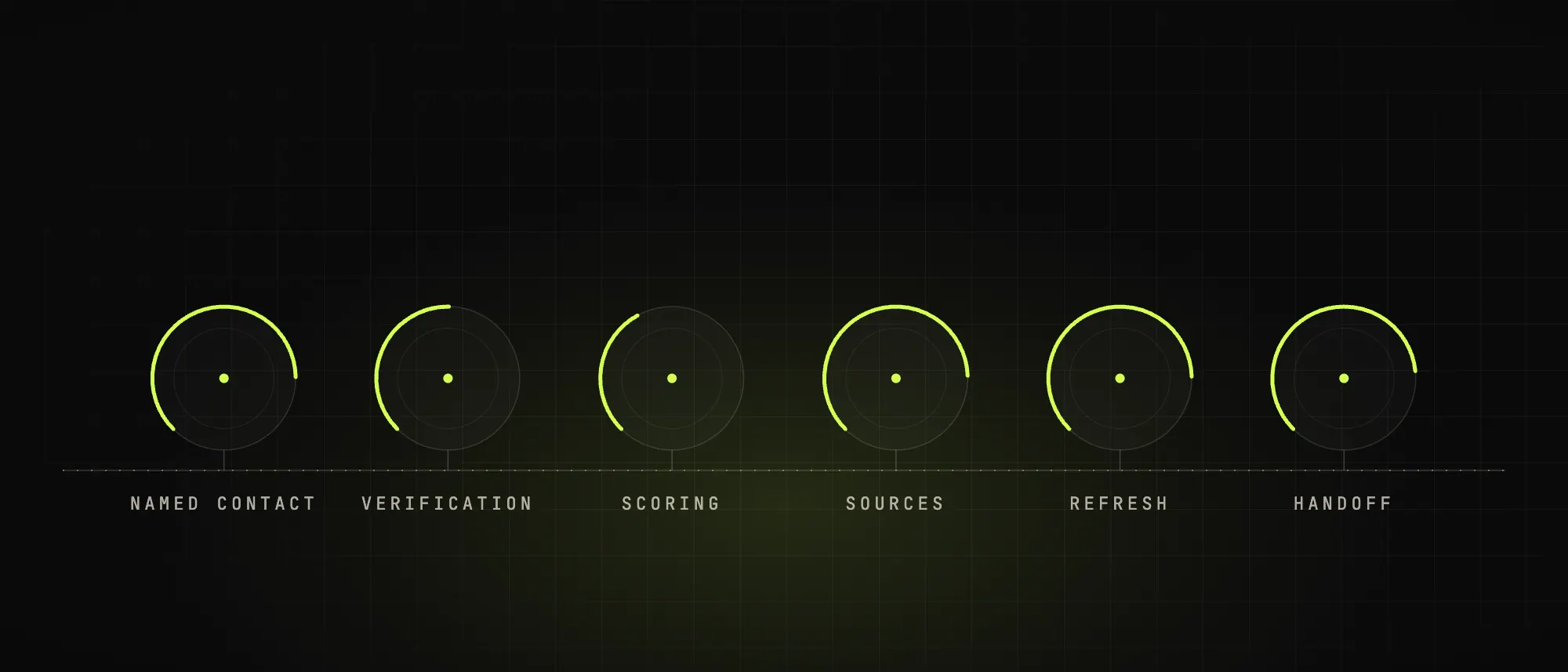
- /01Namedthe person who signs off the work, on every single row
- /02Checkedrows pulled at random and verified against the live source
- /03Scoredranked by how likely they are to need your crew this quarter
- /04Sourcedregistries, property records, permits, listings, reviews
- /05Refreshedrebuilt on a schedule so what you call is current
- /06Handed offpushed into your CRM with the reason for the call attached
Every list, scoped & scored.
Fixed scope per list. Everything below, every build, with the bench discipline that means the list we hand you is the list we would work through ourselves.
- 01
Target + trigger definition
A written brief, the trade, property type, portfolio size, service area and trigger filters, signed off before anything is built.
- 02
Multi-source build
Registries, property and strata records, licensing boards, permits, listings, review platforms, local news, pulled and reconciled.
- 03
Business + property enrichment
Trade, size, years trading, service area, buildings owned or managed, type, age and unit count, layered onto every row.
- 04
Trigger overlay
Change of manager, claim filed, tender posted, permit pulled, sale closed, tagged per record.
- 05
Contact verification
Hunter + ZeroBounce + SMTP triple-check on email, numbers dialled, shared inboxes split out and labelled.
- 06
Fit scoring per row
A score blending what they own, what just changed, and how reachable the decision-maker is, top slice flagged.
- 07
CRM + outbound-tool handoff
Direct push to HubSpot / Pipedrive / Apollo / Smartlead, source-tagged, score-logged, ready to call.
Every source. One row per business.
A real lead-intelligence stack is every available source reconciled against the others. The reconciliation is where a list stops being a phonebook, and it is the part nobody wants to operate.
- Business coreRegistries · OpenCorporates · Apollo · licence boards
- Property + portfolioAssessment records · strata rolls · title data
- ActivityPermit filings · tender boards · public job postings
- Trigger feedsManager changes · claims · sales closed · local news
- ReputationGoogle Business Profile · review platforms · complaints
- VerificationHunter · ZeroBounce · SMTP-ping · manual audit
What owners ask on the second call.
- 01
Why not just buy a list?
- A bought list is a phonebook. It tells you who exists; it doesn't tell you who has the problem you fix right now. We use the bought sources as one input, then layer property records, permits, changes of manager and public complaints on top, and verify the result by hand. Two lists of the same size behave nothing alike once one of them knows the timing.
- 02
How do I know the list is any good?
- We pull rows at random out of every list and check them by hand against the company's own site, its Google listing, and its licence record. If the sample comes back weak, the list goes back to be rebuilt before you ever see it. We would rather miss a Friday than hand your crew a week of dead numbers.
- 03
How much difference do trigger events make?
- 'Property managers in the Lower Mainland' is a list nobody can work through. 'Property managers in the Lower Mainland who took over a building this quarter and are sitting on a roof past its service life' is a list you can work through in an afternoon. Same market either way. The second one gets answered, because the timing matches the reason you are calling.
- 04
Is this compliant with privacy law?
- We work from public business information: registries, property and licence records, business listings, public postings. We keep out of private personal information, we document the basis for each build, and contacts in stricter jurisdictions are routed through a business opt-in before any outreach. We have turned down work before that didn't pass, and we will turn it down again.
- 05
Can you build a list of a competitor's customers?
- Sometimes, where the signals are public: permit records that name the contractor, site signage, reviews that name the company, supplier and trade directories. We work from public records and public postings only, and we will be straight with you about which targets are reachable this way and which are out of reach.

Define the target.
Pull the sources.
Verify the signal.
First the brief is locked. Then the sources are pulled and reconciled. Then the signals are layered and every row scored. Then a person audits the sample and signs it off, and the list lands in your CRM ready to call.
The method, written down.
How we think about this work, in long form, with every outside number linked to its source.
 Intelligence9 min read
Lead intelligence for service businesses: scoring, enrichment, and timing signals
A scraped list is raw material, not a book of work. How lead scoring, multi-source enrichment and timing signals build a layer that feeds every channel.
Read the piece Programmatic12 min read
Programmatic SEO That Ranks After the 2026 Spam Update
Google calls it scaled content abuse. How to build programmatic pages that hold up through the 2026 spam and core updates: make each page the database.
Read the piece Outbound9 min read
Cold Email Deliverability: The Part of Outbound Nobody Talks About
Copy gets the credit, but inbox placement decides whether a word reaches a human. The SPF, DKIM, DMARC and domain warmup stack we run, to the 2024 rules.
Read the piece
Pairs well with.



Want a scored list for your service area?
Tell us who you want to reach. We build a sample, verify it by hand, and send it back with the sources listed.

Want the phone to ring?
A 30-minute call. Tell us the work you want more of and the areas you serve. We’ll show you the searches happening there now, the pages it would take to cover them, and what that costs at $50 a page. You keep that whether or not you hire us.