B2B SaaS Content Marketing Strategy That Compounds Pipeline
A content marketing system for SaaS that compounds: a quarter-mapped editorial calendar, senior writers, and a hub-and-spoke graph built to rank and get cited.

- The March 2026 spam update cut traffic 40 to 90% for sites publishing high-volume content with no unique data or editorial review. Volume without originality is now a liability.
- Plan the quarter before you write a word. A content engine is an editorial calendar mapped to ICP buying questions, not a backlog of post ideas.
- Every piece needs a real senior writer with a byline. Google and AI answer engines both reward identified expertise and first-hand experience.
- Internal links are the lead engine. A hub-and-spoke architecture routes authority to the money pages and keeps readers in your system.
- Monday move: pick one pillar topic you can own with proprietary data, and outline the eight spoke posts that will link up to it this quarter.
Publishing more content stopped working in March 2026, and the sites that learned it the hard way lost 40 to 90% of their organic traffic in a single 24-hour update.
The March 2026 spam update did not punish AI. It punished thin content at scale, sites shipping 50 to 500 templated pages a day with no editorial review, no first-hand experience, and no data a reader could not get elsewhere. Meanwhile, operations publishing 50 to 100 genuinely useful pieces with human editing saw traffic climb 30 to 80%. The lesson is blunt: volume without unique data is now a liability, and a content engine that compounds is built on the opposite premise.
We call our approach the Compounding Content System, and it is the spine of our blog pipeline service. It has five parts that most teams either skip or do backward: plan the quarter before word one, research the surface not just the keyword, put a senior writer on every piece, give each post original imagery, and wire the whole thing with a hub-and-spoke link architecture. Done together, the posts stop being disposable and start reinforcing each other.
Why most content programs publish into the void
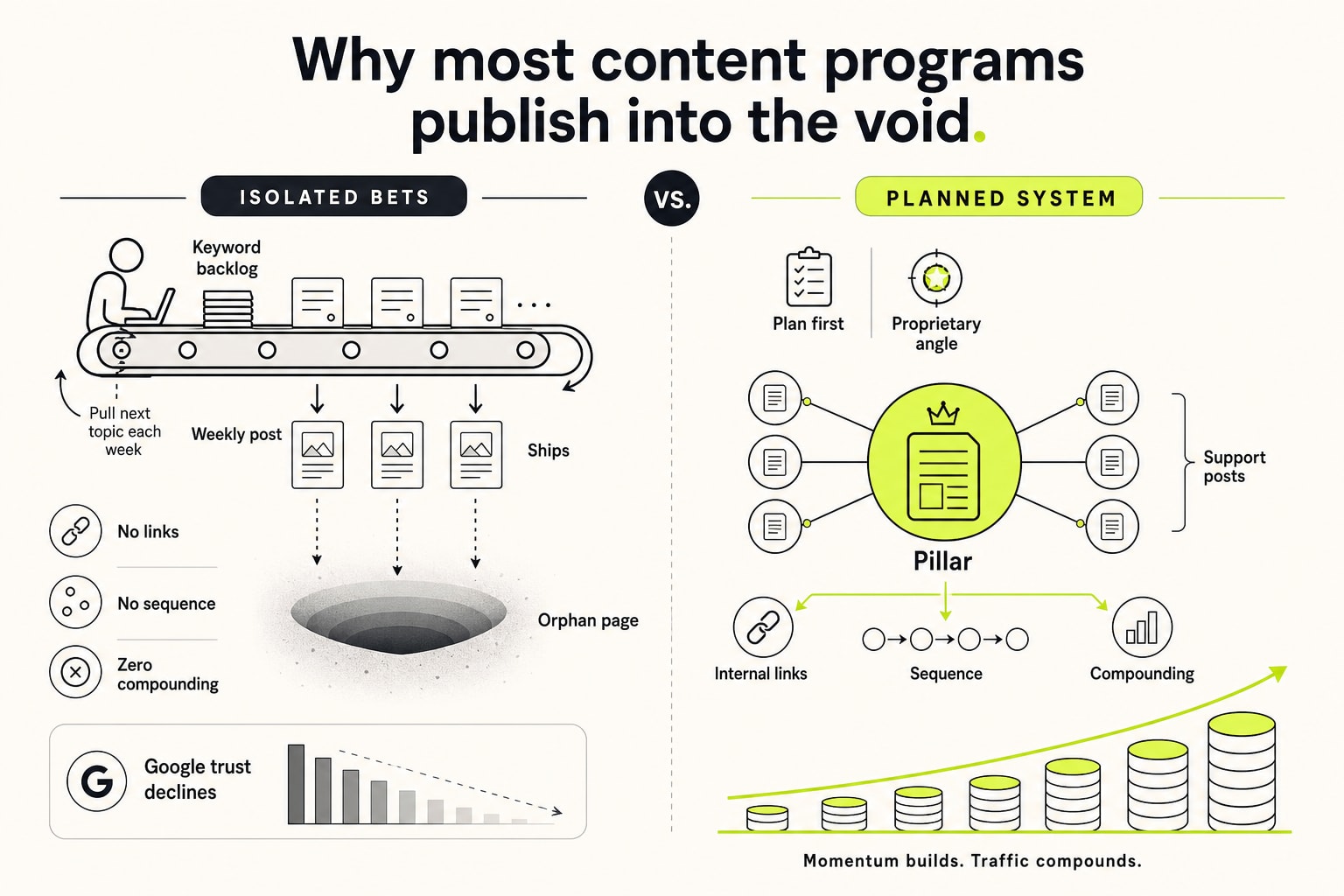
The default content program is a treadmill. Someone keeps a backlog of keyword ideas, a writer pulls the next one each week, the post ships, and it sinks. Nothing links to it on purpose, nothing builds on it, and three months later it is an orphan page that Google has quietly stopped trusting. The work was real and the compounding was zero.
The deeper problem is that the program was never planned as a system. Without a pillar to point at and a sequence to follow, each post is an isolated bet. After the March update, isolated bets with no proprietary angle are exactly the pattern SpamBrain is trained to discount. The fix is not to write more. It is to plan before you write.
Step 1: map the quarter before word one
We plan a full quarter of content before a single draft starts. Each quarter is anchored by one pillar topic the client can credibly own, surrounded by eight to twelve spoke posts that each answer a specific buying question and link back up. The calendar is mapped to the ICP's decision journey, not to whatever keyword looked tempting that week.
Planning ahead is what makes the link architecture possible, because you cannot build a hub-and-spoke graph one orphan post at a time. It is also what keeps the cadence honest: when the quarter is mapped, the weekly publish is execution, not a scramble for an idea. This is the same discipline that makes our programmatic pages scale without tipping into the thin-content trap, structure first, then fill.
- 01Pick the pillar
One topic the client can own with proprietary data or hard-won experience. This is the hub the quarter orbits.
- 02Derive the spokes
Eight to twelve buying-question posts that each deserve to rank on their own and link up to the pillar.
- 03Sequence the cadence
Slot one publish per week so the calendar holds for the full quarter without heroics.
- 04Define the proprietary angle
For each post, name the data, benchmark, or first-hand take that makes it un-copyable.
Step 2: research the surface, not just the keyword
Keyword volume is table stakes and no longer enough. We run three research passes per pillar: a deep ICP pass on the questions the buyer actually asks in calls and communities, a keyword pass for the search demand, and an LLM-surface pass where we ask ChatGPT, Claude, Perplexity, and Gemini the queries the client cares about and read what they cite today. Share of citation is the new share of voice, and you cannot earn it without knowing who currently holds it.
That third pass is where most programs are blind. AI answer engines lift self-contained passages and over-index on identified authors and structured data, which changes how a post should be written, not just what it should target. We tie this research directly into SEO and GEO so the same piece is built to rank in Google and to get quoted inside an AI answer, two surfaces, one asset.
Share of citation is the new share of voice. If you do not know what the answer engines quote today, you cannot plan to replace it.
Shivam Bindal
We map the quarter, run the research, put a senior writer on every piece, and wire the link graph that turns posts into pipeline.
A senior writer and original imagery on every piece
Every post we ship is written by a senior operator with a real byline, not generated and lightly cleaned. This is not a craft vanity. Google's scaled-content enforcement and the AI answer engines both reward identified expertise and first-hand experience, which is precisely what a junior or a model cannot fake. A bylined writer with a genuine career history is now a ranking input, not just a credibility nicety.
Each post also gets original imagery, made for that piece, not a stock photo three competitors are already using. Unique assets signal a real publication to crawlers and hold readers on the page, and the same production discipline feeds our video pipeline when a topic earns a motion treatment. The goal across both is simple: nothing on the page should be reproducible by a content farm.

Step 4: the weekly cadence that holds for quarters
One quality piece per week, every week, for the full quarter. Not five posts in a sprint and silence for a month. The cadence is deliberately modest because consistency is what compounds, and because the quarter was mapped in advance, the weekly publish is a known quantity rather than a recurring emergency.
Modest and consistent beats heroic and sporadic for a structural reason: search engines and answer engines both reward freshness signals and steady topical depth, and an audience only builds a habit around a publication it can predict. By the back half of the quarter, the early posts are ranking, the links are flowing, and the engine starts producing pipeline while you keep feeding it one piece at a time.
The hub-and-spoke link architecture
Internal links are the lead engine, and we treat the link graph as a designed system, not an afterthought. Each spoke post links up to its pillar, the pillar links down to every spoke, and the highest-authority posts route links to the money pages where pipeline actually converts. This concentrates topical authority on the pages that pay rent and keeps readers moving through your system instead of bouncing back to search.
Hub-and-spoke is also how content stops being a cost center and starts being a demand channel. A reader who lands on a spoke from an AI citation can be walked to the pillar, then to the service page, in three deliberate links. The full picture of how content, traffic, and conversion connect is laid out in the B2B SaaS growth operating system, but the content engine is where most of that compounding begins.

Written by Shivam Bindal. Founder, Markingo.
