B2B SaaS Growth Strategy: The Operating System That Compounds
B2B SaaS growth marketing stalls when channels run as separate vendors that never feed each other. Here is one system where each function compounds the next.

- Point solutions add; operating systems compound. The median SaaS now spends about $2 to buy $1 of new ARR, and most of that waste is the gap between channels, not inside them.
- Five functions, one system: Surface, Capture, Reach, Intelligence, and Face. Each one feeds the next or it does not belong.
- Retargeted B2B demo requests convert near 8% versus 2.4% for cold. That lift only exists if your content engine is feeding your paid pixel.
- AI-referred sessions grew 527% in early 2025 and convert 8 to 10x better than Google organic. The blog that earns those citations is the same asset that ranks and the same asset that fills retargeting pools.
- Monday test: if you cannot draw an arrow from each channel into the next on one page, you are paying for parts, not a machine.
The reason most B2B SaaS growth flattens has nothing to do with the SEO agency, the ads freelancer, or the design shop being bad at their jobs. It is that none of them were ever wired to each other. You bought six channels and got six invoices, and not one of them made the other five worth more.
This is the difference between buying parts and buying a machine. A point solution is hired to win on one metric: rankings, cost per click, open rate. It optimizes its own number and ships a report. An operating system is built so that the output of one function becomes the raw material of the next, which means the whole thing gets cheaper to run every month instead of more expensive. Most companies never feel this difference because they never assemble the system. They assemble a vendor stack and call it a strategy.
The math has gotten unforgiving. Private SaaS companies now spend roughly $2 of sales and marketing to acquire $1 of new ARR, a new-CAC ratio that rose about 14% year over year, while median CAC payback has stretched past 23 months. Top-quartile companies still acquire a dollar of ARR for about a dollar of spend. The thing separating those two groups is almost never a single heroic channel. It is whether the channels feed each other or run in parallel, paying full price for the same audience three times.
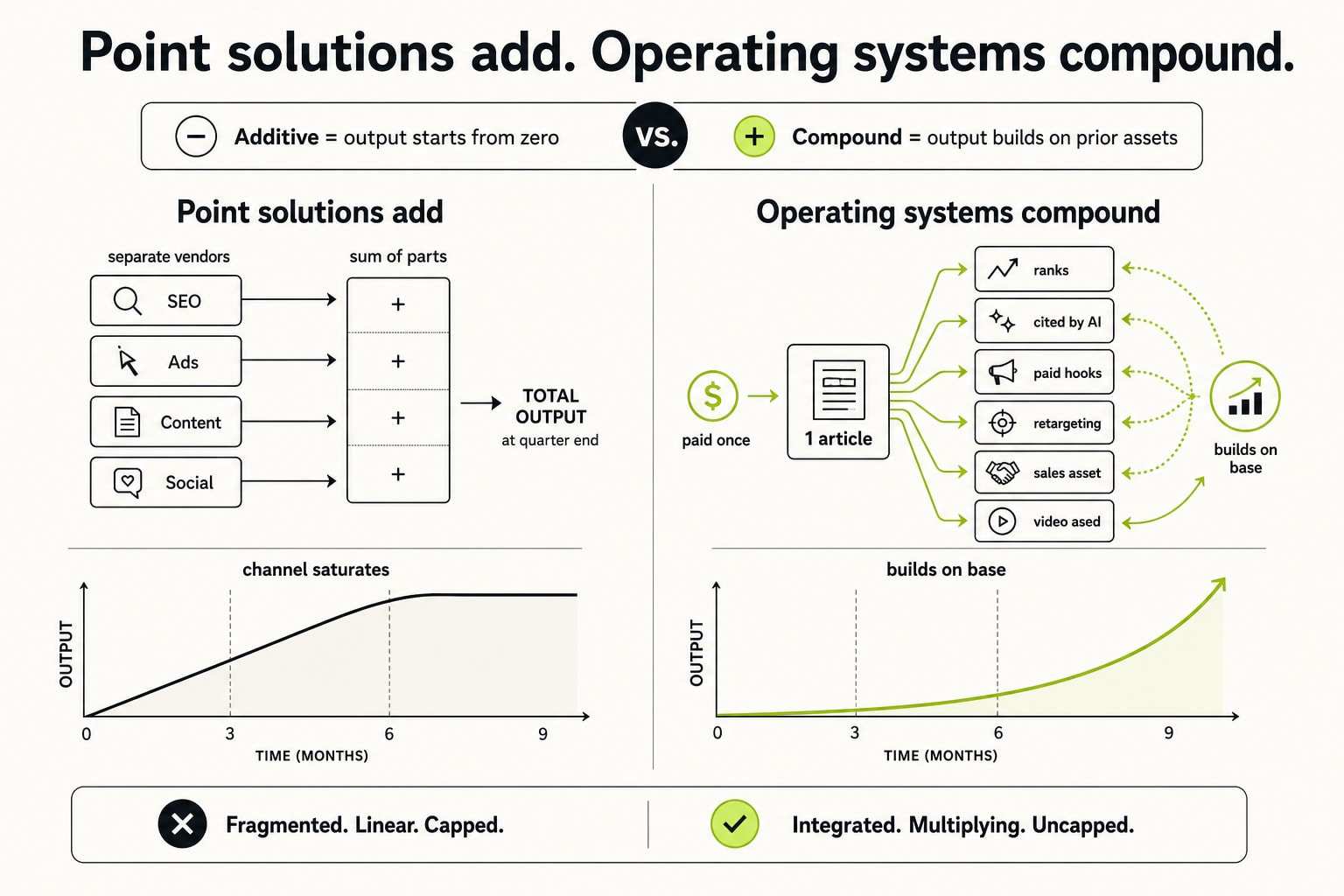
Point solutions add. Operating systems compound.
Adding is what a stack of vendors does. Your SEO agency produces some traffic. Your ads agency produces some leads. Your content freelancer produces some posts. At the end of the quarter you sum the contributions, and the total is roughly the parts. Spend twice as much and you get roughly twice the output, until the channel saturates and the curve goes flat. That flat curve is the lived experience of point-solution growth, and no amount of swapping agencies fixes it, because the ceiling is structural.
Compounding is different in kind. In a real system, one blog post is not one blog post. It is a page that ranks, a page that gets cited by AI search, a source of paid social hooks, a retargeting audience, a sales-enablement asset, and the script seed for a video. The cost to produce it was paid once. The returns accrue across six functions. Run that for nine months and the curve does not flatten, it bends upward, because each new input lands on top of the compounding base instead of starting from zero.

The Growth Operating System: five functions
Here is the named framework we run inside Markingo. It has exactly five functions. Every channel a B2B SaaS company spends money on slots into one of them, and if a channel does not feed the next function, it does not belong in the system. The point is not to do ten things. It is to wire ten things into one loop so that each turn of the loop is cheaper than the last.
- 011. Surface
Create the demand and the answers. This is your blog pipeline, your SEO and GEO surface, your programmatic pages at scale, and your video pipeline. Surface produces the assets that get found, cited, and watched. Everything downstream eats what Surface makes.
- 022. Capture
Turn attention into intent. Your landing pages convert the traffic Surface earns, and paid ads buy reach against audiences Surface has already warmed. Capture is where a click becomes a tracked, scored person instead of an anonymous bounce.
- 033. Reach
Go get the demand inbound cannot wait for. Cold outbound and direct mail hit accounts that match your best customers, using the same proof and the same message Surface is publishing. Reach is proactive; it does not sit and hope.
- 044. Intelligence
Know who they are and where to send them. Data scraping and lead intelligence enrich, score, and route every contact the first three functions produce, so a hand-raiser never lands in a generic nurture and a great-fit account never gets a junior rep.
- 055. Face
Give the whole machine one identity. Creative design is the layer that makes the blog, the ad, the landing page, the mailer, and the video look like one confident company instead of five contractors. One face is what makes the compounding legible to a buyer.
How the parts actually feed each other
A framework is just a diagram until you can name the handoffs. Here is the specific plumbing, in the order the value moves. Read it as a circuit, because that is what it is.
Surface feeds Capture
The blog and the GEO surface do two jobs at once. They rank in traditional search, and increasingly they get cited inside AI answers, which is now its own demand channel. AI-referred sessions grew 527% in the first months of 2025, and traffic arriving from ChatGPT, Perplexity, and Claude converts in the 10 to 17% range against Google organic's 1.76%. That is not a rounding error; it is an order of magnitude. The catch is that the overlap between Google's top-10 results and what AI engines cite has collapsed from roughly 75% to under 40%, so ranking and getting cited are now two separate disciplines that the same content asset has to win. We cover the mechanics in the GEO playbook.
Every one of those visitors lands on a landing page, not a homepage. The page is built for the exact promise the content made, which is why a tightly matched page converts where a generic one leaks. The system we use for that is in the landing page system. And every visitor, converted or not, drops into a retargeting pool. That is the bridge to the next handoff.
Capture feeds Paid, and Paid feeds itself
Cold paid traffic in B2B SaaS is expensive and converts poorly, often under 2% to a demo. Retargeted traffic, the audience your Surface function already warmed, requests demos at around 8% and costs 40 to 60% less per qualified lead. So paid ads are not a cold-acquisition channel in this system. They are an amplifier sitting on top of Surface, re-touching people who already read the post, watched the video, or bounced off the page. Run paid without a content engine feeding the pixel and you are paying cold prices forever. Wire it to Surface and your blended CAC drops without spending an extra dollar on media.
Intelligence routes everything
Now you have inbound demos, retargeted hand-raisers, and a list of cold accounts you want to reach. Lead intelligence is the function that enriches each one, scores fit and intent, and routes accordingly. A 9-out-of-10 fit account that just hit your pricing page does not get a templated email; it gets a same-day, named-rep play. This is also where attribution stops being a vanity exercise and starts being a routing input, which is the argument I make in attribution is theatre. You do not need perfect attribution. You need to know who to call first.
Reach captures the demand inbound creates
Surface creates awareness across a whole category, not just the people who happened to search this week. Outbound and direct mail go capture that latent demand directly, and they convert dramatically better when the prospect has already seen your name in an AI answer or a feed. The mailer references the same proof point the blog post used. The cold email opens with the same insight the video led with. Reach is not a separate brand; it is Surface, delivered to a named list instead of waiting to be found.
The same logic runs in the other direction, too. When programmatic pages publish a few thousand indexable pages targeting the long tail of how buyers describe their problem, those pages are not just SEO inventory. They are the source list Intelligence mines for intent, the proof Reach cites in a first line, and the destination paid sends warmed clicks to. One investment, built once, paying four functions at once. That is what people mean when they say content is an asset and not an expense, except most companies never wire the asset to anything, so it sits there earning traffic and nothing else.
Face holds it together
None of this compounds if the buyer experiences it as five different companies. Creative design is the connective tissue: one visual system across the ad, the page, the mailer, the deck, and the video, so that the fourth touch reinforces the first three instead of resetting them. Brand consistency is not a luxury layer you add at the end. It is the thing that lets six touches feel like one relationship, which is the entire mechanism behind the compounding curve.

You do not have a growth problem. You have a wiring problem. The channels are fine; the gaps between them are eating your budget.
Shivam Bindal
The compounding curve, with real numbers
Here is why the curve crosses. In month one, the operating system looks slower than a point solution, because you are building the base: the content surface, the pixel, the enrichment, the brand system. A pure paid play will out-produce it for a quarter. SEO and GEO investment typically break even at 6 to 9 months, and the compounding only starts after that. So for the first two quarters, the vendor-stack company looks like it is winning.
Then the curve bends. By month nine, the content surface is ranking and getting cited, which fills the retargeting pool for free, which drops paid CAC, which funds more Surface, while the same assets give Reach better proof and Intelligence better routing. Each function is now lowering the cost of the others. The point-solution company, meanwhile, has hit the saturation ceiling on every channel independently and is paying more for each additional unit of output. One curve is flattening; the other is bending up. That gap is the whole game, and it compounds, so it widens every month you let it run.
This is also why swapping vendors never fixes a flat curve. If your SEO agency plateaus and you replace it with a better one, you have changed the height of one flat line, not the shape of the system. The structural ceiling is still there, because the new agency is still optimizing in isolation and still handing its output to nobody. The only move that changes the shape of the curve is wiring, and wiring is precisely the thing a single-channel vendor is neither hired nor incentivized to do. That is the case for owning the operating system, whether you build it in-house or hire one team to run the whole loop.
We map your current stack, find the broken handoffs, and wire the functions into a single operating system. One team, one face, one compounding loop.
How to tell if you need this
Not every company needs the full system today, and an honest diagnostic matters more than a sales pitch. Here is how to tell where you actually are.
You probably need an operating system if: you are running three or more separate vendors who never talk to each other; your content gets traffic that never shows up in your pipeline; your paid CAC has been flat or rising for two quarters; nobody on your team can draw, on one page, how a blog reader becomes a retargeting impression becomes a sales call; or your brand looks like a different company on every channel. Each of those is a broken handoff, and broken handoffs are exactly the gaps that eat the 14% CAC inflation we opened with.

You probably do not need it yet if: you have not nailed product-market fit and are still changing your ICP every month; you have one channel that is genuinely working and not saturated, and you have not exhausted it; or you are pre-revenue and need to validate, not compound. Compounding only helps once there is a real base to compound. Build the base first, then wire the system.
- Count your vendors. Three or more with no shared roadmap is a wiring problem.
- Trace one lead end to end. If you cannot, the handoffs are missing.
- Check your retargeting pool. If it is empty or tiny, Surface is not feeding Capture.
- Look at five touchpoints side by side. If they look like five companies, you have no Face.
- Pull your blended CAC trend. Flat-to-rising over two quarters means the parts have hit their ceiling.
What to do Monday
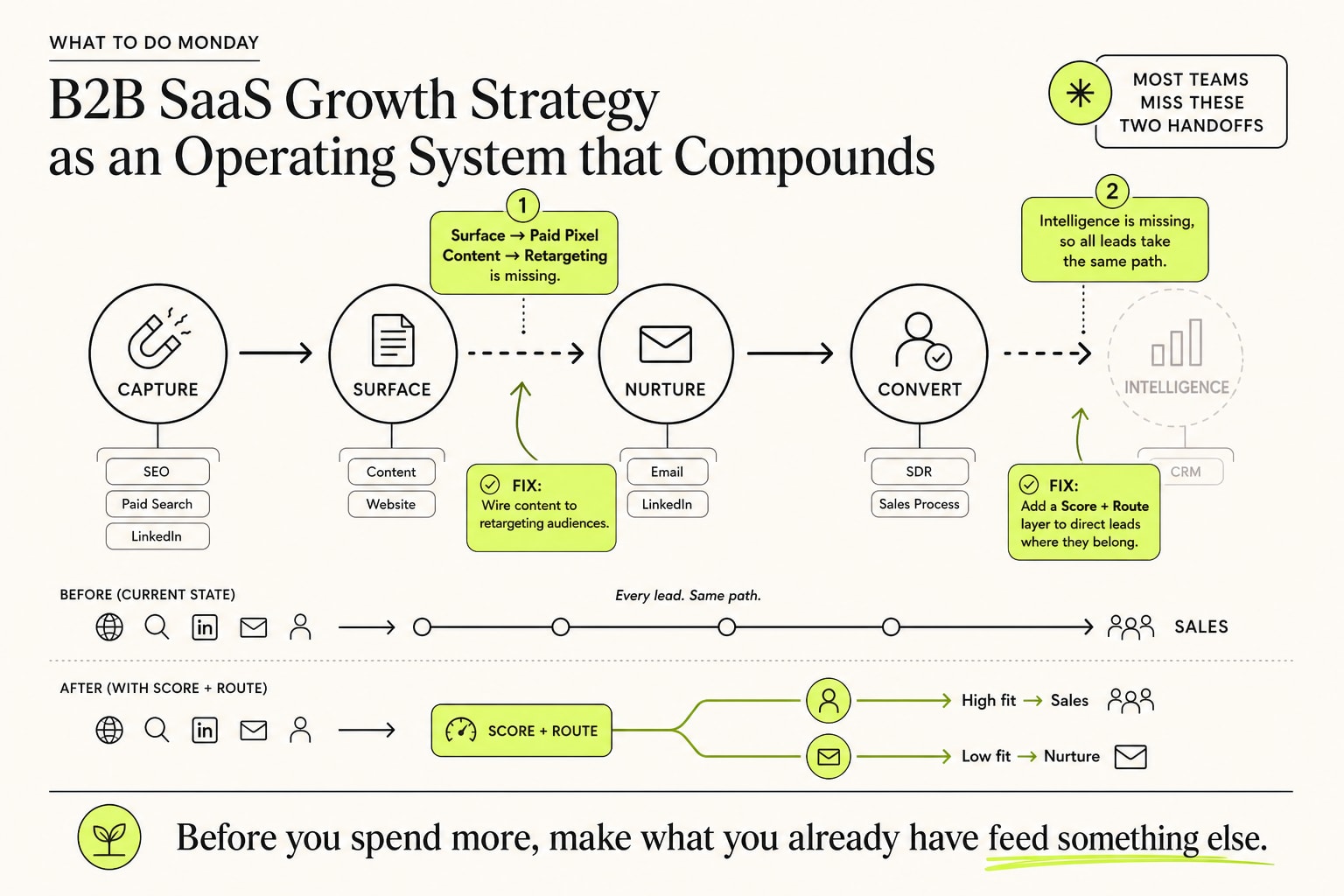
You do not have to buy all ten services or rip out your stack to start thinking in systems. Do the diagnostic first. Draw the five functions on a whiteboard, place every channel you currently pay for into one of them, and then draw the arrows for how output moves between functions. The empty arrows are your priorities. Most teams find the same two gaps: Surface is not feeding the paid pixel, and Intelligence does not exist, so every lead gets the same generic routing regardless of fit.
Fix those two handoffs before you add a single new channel. Wire your content engine to your retargeting audiences, and put a real scoring-and-routing layer between your lead sources and your sales team. Those two changes alone move CAC, because they stop you paying cold prices for warm audiences and stop you sending great-fit accounts into the same nurture as everyone else. That is the operating-system mindset in one sentence: before you spend more, make what you already have feed something else.
Written by Shivam Bindal. Founder, Markingo.
