High-Converting Landing Page Design: The System We Run
The landing page system we run for local service businesses: positioning, conversion copy, design, build and instrumentation, in a fixed order that holds.
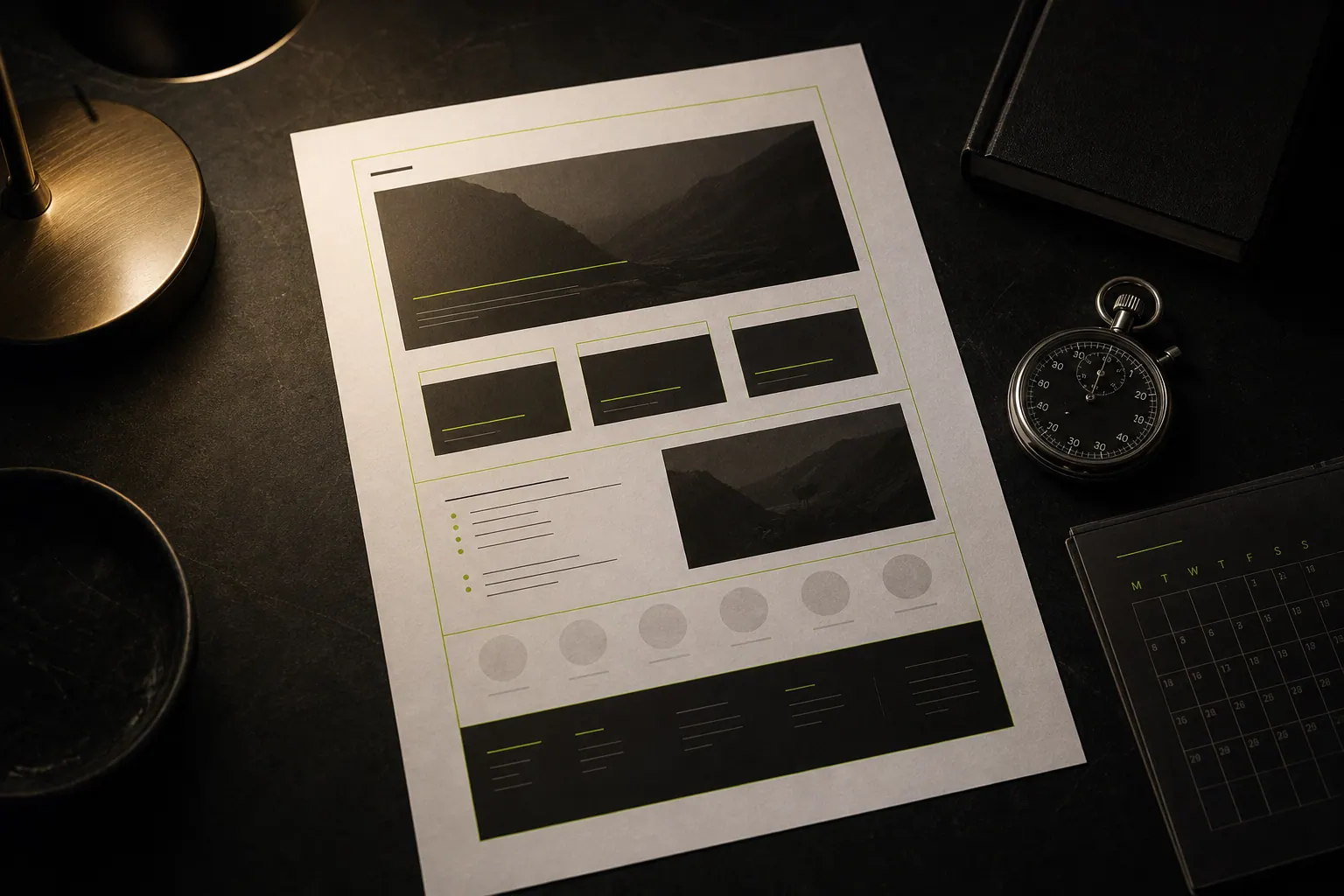
- The gap between a page that books jobs and a page that just sits there is positioning and sequence, not polish.
- Lock the wireframe order before a word is written: hero, belief-shifts, objection handling, proof, pricing teaser, FAQ, CTA. No exceptions.
- Copy and design run in parallel against one doc, not in a relay. Every handoff in a relay loses a little signal and a little time.
- Aim well inside Google's 2.5 second LCP line on field data. In Deloitte's 2020 study for Google, a 0.1 second mobile speed gain went with 8.4% more retail conversions.
- Monday move: write your positioning on one page answering who, what, and why now. If you cannot, the page is not the problem yet.
Most service business landing pages lose before the first pixel ships, because the team treated the page as a design problem when it was a positioning problem wearing a design costume.
Two companies can sell the same service in the same city and book work at very different rates off the same amount of traffic. That spread is not a font choice. It is the difference between a page that argues one specific job to one specific customer in one specific area and a page that lists every service you offer and hopes. Our landing pages practice exists to close that spread, and the target is plain: we aim to beat the page you are running today on its primary conversion, measured against a baseline recorded before the rebuild.
This is the system. Not a philosophy, a sequence. Named stations, run in order, and one deliverable that ships positioning, copy, design, build, and instrumentation as a single unit instead of 5 handoffs that each lose a little signal.
Why most service business landing pages lose
The common failure is not ugliness. It is a page that never decided who it was talking to. Generic positioning produces generic copy, which produces a hero that could belong to any of the other companies working the same city. The visitor reads the first screen, fails to see their own problem, and leaves. No amount of gradient or motion saves a page that did not pick a fight.
The second failure is order. Teams write the sections they enjoy writing, then arrange them by taste. But a landing page is an argument, and arguments have a sequence. You cannot ask for the call before you have shifted the belief that was blocking it.
Step 1: positioning on one page
Everything downstream is a writeup of a single page that answers 3 questions: who is this for, what do you do that the company down the road does not, and why call now. We pressure-test it against the actual phone calls and the actual reasons quotes go cold, not against what the owner wishes were true. If the positioning cannot survive a skeptical homeowner reading it aloud, no headline will rescue it.
We give this step real time because it is the cheapest place to be wrong. A bad sentence here costs an edit; a bad premise found during the build costs the build. Strong positioning also feeds the rest of your marketing, which is why it ties into how we run SEO and GEO: the same sharp, standalone claim that converts on the page is the kind of passage an AI engine quotes when someone asks who to call in their city. The GEO playbook explains why.
Step 2: the fixed wireframe order
Before copy or design starts, we lock the section order. It does not change per client, because the way someone picks a contractor does not change per client. The sequence is the product.
- 01Hero
One sharp claim plus immediate proof. The visitor should know which service this is, which areas you cover, and why you are different at a glance.
- 02Belief-shifts
3 sections, each dismantling one assumption that keeps the customer from picking up the phone. This is the persuasion engine.
- 03Objection handling
Name the real hesitation out loud (price, how fast you can get there, whether you are licensed and insured) and answer it before it festers.
- 04Proof
Reviews, job photos, a named quote from a customer in the same area, a short job walkthrough film. Evidence the claim is true, placed after the argument that made the claim matter.
- 05Pricing teaser
Enough to qualify and anchor, not the full price list. The job is to remove the fear of a surprise invoice, not to close the job here.
- 06FAQ
The questions your office actually gets on the phone, answered in complete sentences. Doubles as your AI-answer surface.
- 07CTA
One primary action, repeated. Asked only after the belief is shifted and the objection is dead.
The order is the part teams want to negotiate and the part we will not. Proof before argument is wasted. A CTA before objection handling is a button nobody is ready to press. Hold the sequence and the page does the persuasion work that polish cannot. For the proof section, a short film of a real job does more than a gallery; the video pipeline post covers how that footage gets made without a shoot per page.
We ship the positioning, copy, design, build, and instrumentation as one unit, built to beat the page you have now.
Copy and design at one desk
Running copy first and design second as a relay is where timelines go to die. We aim to run the writing and the art direction against the same doc at the same time, building the same argument in two materials, so neither side waits on the other.
Parallel work only succeeds with experienced people on both sides. This is why our creative design work sits inside the build. The visual system and the words are decided together, so the page reads as one voice.
Copy and design are not two phases. They are two views of the same argument, and they should be written at the same desk.
Shivam Bindal
A fast build on the stack you own
We build on the stack you already own and can keep editing, WordPress, Webflow or a custom Next.js build, with the mobile layout built first. The bar is Google's: a Largest Contentful Paint of 2.5 seconds or less at the 75th percentile of page loads. We aim to land well inside it on field data from real phones, not only in a lab test.
Speed is conversion infrastructure, not a vanity metric. In Deloitte's 2020 study for Google, which followed 37 brands and more than 30 million sessions, a 0.1 second improvement in mobile site speed went with 8.4% more conversions on retail sites and 10.1% more on travel sites. That matters most on the emergency searches, where the customer is standing in the problem on a phone and calls whoever loads first. It matters double when paid ads are feeding the page, since you pay for every visitor who bounces on load.
Step 5: instrumentation before launch
A page you cannot read is a page you cannot improve. Before launch we wire an event model (scroll depth, section views, tap-to-call clicks, quote form starts and completions), session replay on key segments, and real-user speed monitoring to hold the LCP number honest in the wild, using tools like PostHog or GA4 and Hotjar. Every lead form is tagged with the page it sits on. The first A/B test is primed and staged, not shipped, because you cannot test against a baseline you have not measured.
The instrumentation is designed around the wireframe. Each section emits an event, so when the page books fewer jobs than it should we can see exactly which belief-shift the visitor scrolled past and which objection sent them away. That is the difference between iterating on data and iterating on opinion, the same principle behind measuring paid channels by incrementality rather than by dashboard credit.
The readout cadence
We ship and start measuring. The first readout comes once there is enough traffic to be meaningful, and we read the funnel section by section rather than staring at the top-line number. Where do visitors drop, which CTA pulls calls, which objection block is getting skipped. From there the A/B program runs one change at a time, so each change can be attributed, until the page clearly beats the baseline.
The landing page is one node in a larger system. It converts best when the traffic reaching it already matches the service and the city, which is what the SEO page libraries are built to send it.
Sources
- 01web.dev, Google, 2025. Largest Contentful Paint (LCP)
- 02Deloitte, commissioned by Google, 2020. Milliseconds make millions
Written by Shivam Bindal. Founder, Markingo.