Markingo is one team in place of the five vendors a SaaS launch usually needs. Strategy, product demo videos, weekly social, a site that ranks in Google and gets cited in AI answers, paid ads, outbound and direct mail, built as one system from one strategy.
Vertical B2B SaaS selling into healthcare, accounting, construction, legal, insurance, real estate, HR and compliance.
The five-vendor problem
Five vendors, five briefs, and nobody owns the launch.
Most SaaS teams assemble go-to-market from specialists: a strategy consultant, a video studio, a social agency, an SEO agency and an ads or outbound shop. Each can be good at its piece. None of them is responsible for the whole.
The usual stack · brief, positioning, timeline, report
Brief
Positioning
Timeline
Report
Strategy consultantIts ownIts ownIts ownIts ownIts own
Video studioIts ownIts ownIts ownIts ownIts own
Social agencyIts ownIts ownIts ownIts ownIts own
SEO agencyIts ownIts ownIts ownIts ownIts own
Ads and outbound shopIts ownIts ownIts ownIts ownIts own
Markingo, one teamOne of eachOneOneOneOne
01
Five readings of the positioning.
Each vendor turns your positioning into its own version. The demo leads with one benefit, the ads with another, the landing page with a third, and a buyer who sees all three meets three different products.
02
The founder becomes the project manager.
Someone has to brief five teams, chase five timelines and settle the arguments between them. In a lean SaaS company that someone is a founder or the only marketer, and it becomes their whole week.
03
Hand-offs eat the calendar.
The SEO agency waits on the video. The ads shop waits on the landing page. Every hand-off between vendors is a queue, and a launch is a chain of them.
04
Nobody owns the pipeline.
Each vendor reports on its own channel: views, rankings, clicks, replies. Five dashboards, and no one accountable for whether the launch produced qualified conversations.
One team, one strategy document. The person who wrote the positioning reviews the script, the pages, the posts and the ads, so the launch says one thing everywhere it shows up.
What we build
Every piece of the launch, built by one team.
Ten workstreams in three groups. Where a workstream has its own page, the page goes deeper on how the work runs, what you get and what it takes from your side.
Meta, Google, YouTube and LinkedIn, with the creative made in house, so a new angle goes from idea to live ad without a second agency.
Outbound
Cold email and LinkedIn from warmed domains, sent to enriched lead lists built from the ICP, with copy written per segment.
Direct mail
Postcards and printed packages for the high-value accounts worth a physical touch, timed to land inside the outbound sequence.
Paid ads
Meta, Google, YouTube and LinkedIn, with the creative made by the team that made the demo.
Outbound
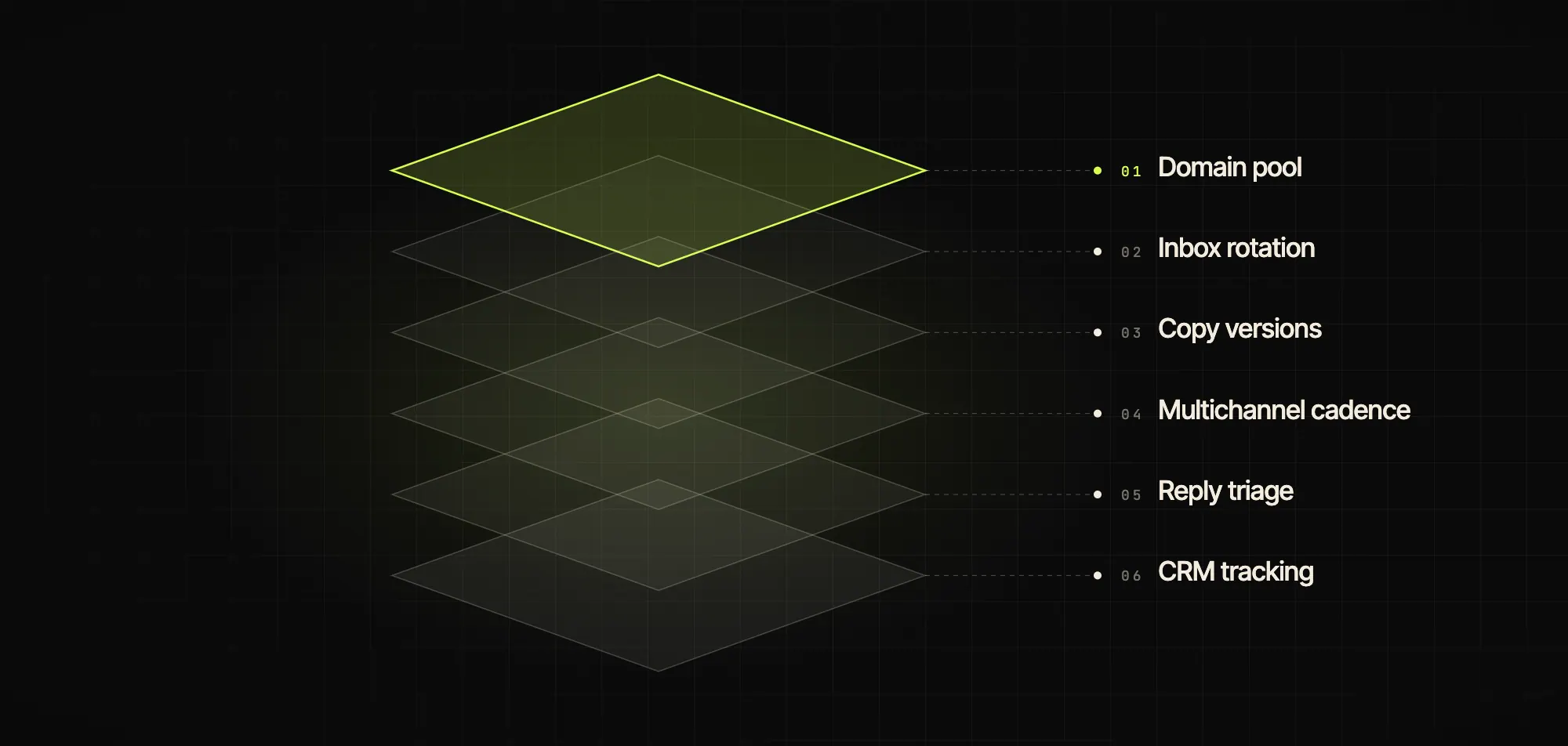
Warmed domains, rotated inboxes, copy per segment and replies triaged by a person.
Direct mail
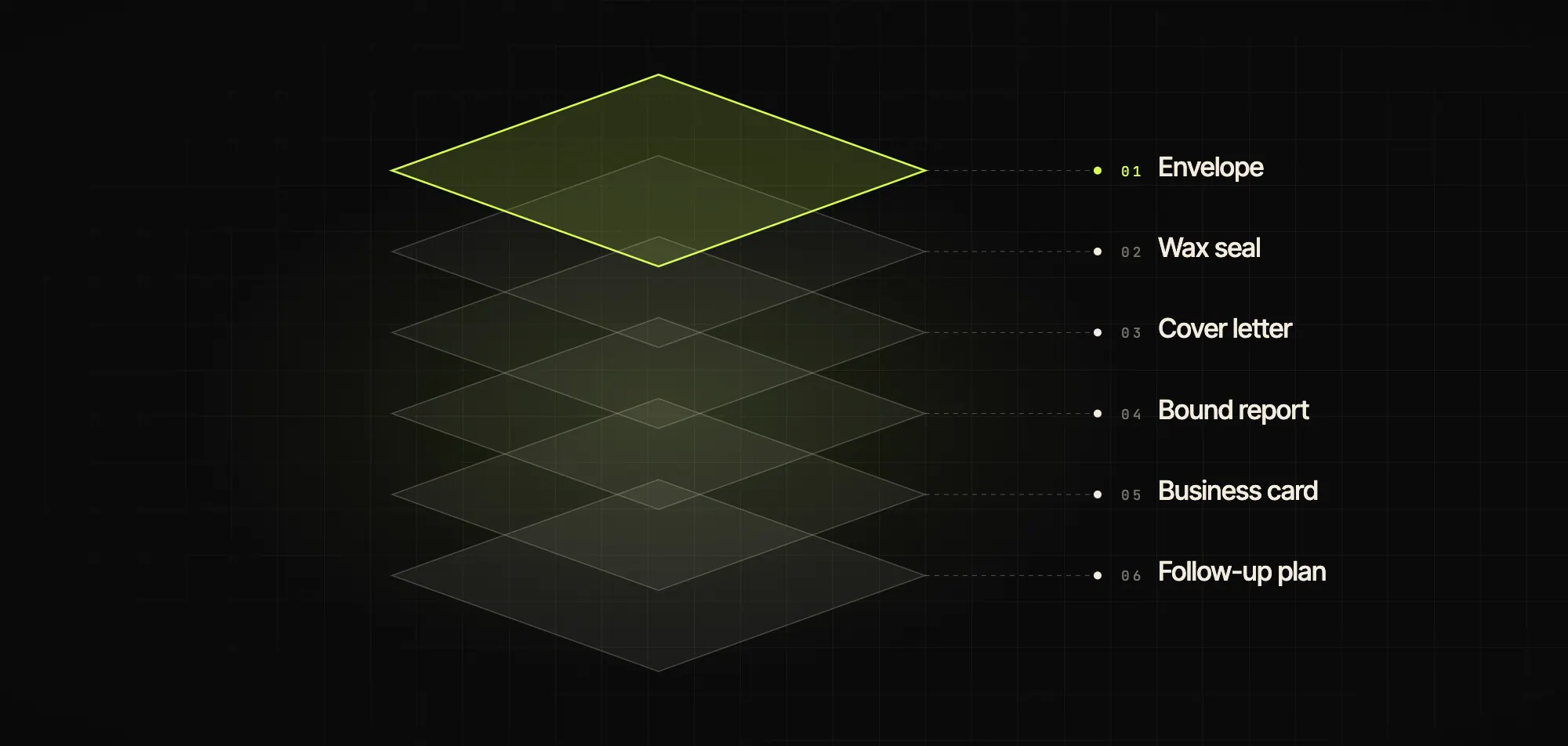
Printed packages for the named accounts where one physical touch is worth the cost.
How an engagement runs
Strategy first. Then build, launch and run.
Every engagement runs in the same order. Nothing is produced until the strategy is written and signed off, because every later piece is briefed from it.
/01Setup quarter opens
Strategy sprint
We read your sales calls, your CRM, your win and loss notes, and the sites of the alternatives your buyers weigh you against. Out of it comes the strategy document: ICP, positioning, messaging by buyer, and a channel plan in priority order.
You get
ICP and buying committee
Positioning and messaging
Channel plan in priority order
What we will measure
/02Setup quarter
Build
The setup quarter builds what the strategy calls for: the site and landing pages, the page library, the demo master and its cuts, the first month of social, ad accounts and creative, outbound domains and lists.
You get
Site and pages on your domain
Demo master plus cutdowns
Social calendar and first batch
Ads, outbound and tracking set up
/03Setup quarter
Launch
Channels switch on in the order the plan sets, not all at once. Search pages ship in phases, outbound starts on warmed domains, and paid starts small to find the angles worth scaling.
You get
Pages released in phases
Outbound sequences live
First paid tests
Mail to the first named accounts
/04Monthly
Run
The monthly retainer keeps the cadence: new pages, weekly social, fresh ad creative and refreshed lead lists, with a monthly readout on what to do more of and what to stop.
You get
Weekly content
Monthly creative refresh
Monthly readout
Strategy revisited each quarter
Nothing moves into the build until you have signed off the strategy document, and it stays yours, like everything else we make. What goes into the strategy.
Built for regulated SaaS
HIPAA-aware,from the first form.
Software for healthcare, insurance, legal and finance sells to buyers who read the fine print, and the marketing has to hold up to the same reading. For healthcare SaaS, that means tracking, forms and tools are planned around protected health information before anything is built.
We are not your compliance function and we do not certify anything. We build the marketing so your reviewer’s job is short, and your compliance or legal team signs off before anything goes live.
Tags are reviewed page by page and kept off anything where health information could be entered or inferred.
Forms that do not invite PHI
Demo and contact forms ask only for what sales needs, with a plain note not to include patient details.
BAA-covered tools where PHI could be involved
If a flow could carry PHI, it runs on tools that will sign a Business Associate Agreement.
Consent before tracking
Consent management set up for the regions you sell into, so analytics load only when they should.
Claims with a source
Every product claim is tied to a source in a claims log your reviewer can check line by line.
Synthetic data on screen
Demo videos and screenshots use made-up records, never a real customer's data.
AI-powered, senior-led
AI does the volume. People do the judgment.
AI is what lets one team cover ten workstreams. It does not decide what your company says. Every piece that reaches a buyer is written or edited, and checked, by a senior person.
Where AI does the work
Account and market research at scale
Enrichment and cleaning of lead lists
First drafts and variants to choose from
Personalized first lines for outbound
Resizes and cutdowns of a master edit
Checks for broken links, missing schema and off-brand terms
Where senior people do the work
Positioning and messaging
The final copy on every page, script and post
Creative direction for video and design
Which channels to run and which to stop
QA on everything before it ships
Every conversation with your team
If a sentence goes out under your name, a person read it first.
Proof, honestly framed
What we can show you today.
We have not published a SaaS case study yet, so we will not imply one. Here is what is real: a search build with measured results, a founder who has been on both sides of a software sale, and a free tool you can run on your own site.
The search method
A 400-page search build, measured.
+67%
clicks per quarter, 1,581 to 2,647
11.2
average Google position, from 25.8
+77%
impressions per quarter, to 428k
349
queries ranking that were not ranking before
91.5%
of search traffic non-branded, from 10.4%
$0
spent on ads to get there
A residential cleaning company in Vancouver, BC, name withheld by agreement, 400 pages over 12 months. It is a service business, not SaaS. It is here because the method is the one we use for SaaS page libraries: research the searches, approve one page, build the library in phases, and measure it in Search Console.
How the SaaS version works Search Console, Feb to Apr 2025 vs Mar to May 2026. Branded split from SEMrush, Aug 2024 vs Apr 2026.
The founder
Shivam Bindal
Started in accounting, doing bookkeeping and accounts receivable for construction and education businesses, with a BCom in Accounting and Finance. Then founded Singoa, an accounts receivable SaaS. He has been the buyer these products sell to, and the founder trying to reach that buyer.
Vertical SaaS, sold to industries that buy carefully.
Our best work is for B2B software sold into traditional industries, where buyers are experts in their own field, skeptical of generic marketing, and reachable through more channels than LinkedIn alone.
01
Healthcare SaaS
We write to: Practice managers, revenue cycle leads, clinical ops and the IT reviewer.
02
Accounting SaaS
We write to: Firm partners, controllers and the ops lead who owns the close.
03
Construction SaaS
We write to: Owners, project managers, estimators and the office manager.
04
Legal SaaS
We write to: Managing partners, legal ops and practice administrators.
05
Insurance SaaS
We write to: Agency principals, carrier ops and claims leaders.
06
Real estate SaaS
We write to: Brokers, property managers and portfolio operators.
07
HR SaaS
We write to: HR directors, people ops and payroll administrators.
08
Compliance SaaS
We write to: Compliance officers, risk leads and internal audit.
Signs we will work well together
A product in market with paying customers
A sales-assisted motion: demos, trials with a sales touch, or both
Buyers outside tech, such as owners, partners, controllers or practice managers
A founder or marketing lead who wants one accountable team
Plans
A setup quarter, then a monthly run.
Each plan opens with a one-time setup quarter that builds the system, then a monthly retainer that keeps it running. Ad spend and print are billed at cost, separate from the fee.
/01Month-to-month after setup
Foundation
A SaaS team putting its first real go-to-market system in place: positioning, a site that ranks, demo video and a steady social cadence.
Every monthly line has a published unit price, so a plan can be trimmed or extended to fit the channels the strategy says to run. You own the pages, the videos, the source files and the accounts.
It plans and runs the work that turns a product into pipeline: who to sell to, what to say, and which channels carry the message. At Markingo that covers GTM strategy, product demo videos, weekly social content, a website and page library built for Google and AI search, paid ads, outbound, direct mail, and the sales decks and creative that tie them together, all built by one team from one strategy.
02
Why one team instead of five specialist agencies?
Specialists can be excellent at their piece. The cost is in the gaps: five briefs, five versions of your positioning, and a founder managing the hand-offs. With one team, the person who wrote the strategy reviews the demo script, the pages, the posts and the ads, and one monthly readout covers every channel.
03
Do you have SaaS case studies?
Not published yet, and we would rather say so than imply otherwise. What we can show is the method: a 400-page search build for a residential cleaning company in Vancouver took quarterly clicks from 1,581 to 2,647 with no ad spend. It is a service business, and the research, page and measurement method is the one we use for SaaS page libraries. The founder has also built an accounts receivable SaaS.
04
Which SaaS companies are the best fit?
Vertical B2B SaaS selling into healthcare, accounting, construction, legal, insurance, real estate, HR and compliance, with a product in market and a sales-assisted motion. Those buyers respond to marketing that shows it understands their work, which is what the strategy sprint is for.
05
Where does AI fit, and who checks the work?
AI handles research, enrichment, first drafts, personalization and resizing, which is how one team covers every channel. Senior people own the strategy, write and edit the final copy, direct the creative, and check everything before it ships.
06
How do you handle HIPAA for healthcare SaaS?
We build HIPAA-aware marketing for healthcare SaaS: no PHI in ad pixels or analytics, forms that do not ask for it, and BAA-covered tools anywhere PHI could be involved. Compliance is your organization's call, so your compliance or legal team reviews and signs off before anything goes live.
07
Can you work with our existing site, brand and team?
Yes. The strategy sprint starts from what you already have. We build on the stack your site runs on, extend the brand you have rather than replacing it, and if there is a marketer in house we work as the team behind them.
08
How does pricing work?
Three plans, each with a one-time setup quarter and a monthly retainer: Foundation at $12,000 setup and $4,000 a month, Engine at $17,500 setup and $7,500 a month, Dominance at $25,000 setup and $12,000 a month. Ad spend and print are billed at cost, separate from the fee, and the full breakdown is on the pricing page.
Tell us what you sell and who buys it.
One line on the product and one on the buyer is enough to start. We reply with the first moves we would make, and a time to talk if you want one.
Go-to-market for B2B SaaS
One team for the whole launch.
A 30-minute call. Tell us what you sell, who buys it and where the pipeline stalls. We come back with the first moves we would make and what the setup quarter would include, whether or not you hire us.